

Reading some of the reactions to Airbnb's new host policy, you'd think we all need to dust off the lockbox, cancel the smart locks and go back to meeting every guest at the door like it's 2019.
Good news: nobody is driving to the property at midnight. Most of this was already the rule since May 2025. For operators, two things really change: rental agreements and ID collection.
Everything else is tighter wording or no change at all.
Airbnb announced the change on October 20 and published it as a new policy, Limiting host imposed contracts and other requirements. It replaces the Off Platform Policy that took effect in May 2025. The cutoff is the booking date, not the stay date. A guest who booked in August for New Year's stays under the old rules. A guest who books on November 21 for the same weekend is under the new ones.
It's worth stepping back for a second. Airbnb has tightened these rules before, and it will likely do it again. Property managers feel like they're losing control of the guest experience they worked hard to build. Airbnb is protecting its business at a time when AI agents and more than 300 short-term rental tech providers, according to Abode Worldwide's STR Tech Index 2026, are helping operators drive direct bookings and revenue outside the platform. Its goal is a consistent digital experience across very different kinds of inventory. Both things can be true.
So here is the calm version: what really changed, what kind of changed, and what didn't change at all. Then what it means for Enso Connect.
What really changed
Three things are genuinely new. Only the first two matter for most operators.
Topic | Before (bookings until Nov 19) | Now (bookings from Nov 20) |
|---|---|---|
Rental agreements | Any contract was allowed if the terms were disclosed | Only when a law or HOA requires one, for an optional amenity, for 28+ night stays, or for Luxe |
ID collection | ID photos before arrival needed a "legal or compliance" reason, a catch all many used for security or insurance | Only a law, a documented HOA rule or an allowed contract counts. It covers the whole stay, and no copies, even at the door |
WiFi portals | Not mentioned | No splash pages asking for email or personal info, outside hotels and resorts |
Also new but minor: hosts can't pressure guests into timeshare pitches, subscriptions or memberships, and commissions on local recommendations must be disclosed. A companion policy on house rules also bans checkout chores and host fines, and stops hosts from adding rules after booking.
What "kind of" changed
Same direction as 2025, just written more clearly. If you were following the old policy, you are mostly fine here.
Topic | Before | Now |
|---|---|---|
Contact details | Not before booking, not solicited through Airbnb messaging | Not at any point, unless an exception applies |
Background and credit checks | Couldn't collect contact details to run them | Named directly as off limits |
Selfies and biometrics | Already covered as ID photos | Facial recognition and fingerprints named explicitly |
Check in apps | Had to be optional | Still optional. Can't gate entry or a critical amenity, and an alternative must be offered on request |
Exceptions | Disclose in the listing description | Disclose in the requests section, collect only what's required, store and delete securely |
What didn't change
Digital check in and guest portals are still allowed, as long as guests aren't forced to use them
Guest registration required by law, like across much of Europe, is still allowed
Airbnb has verified every booking guest since 2023, so hosts were never the only ID check
Asking for reviews off Airbnb was already banned
Security deposits and mandatory damage waivers follow the same pricing policy as before
Bookings made before November 20 keep the old rules, even for stays next year
What stays the same: getting guests in
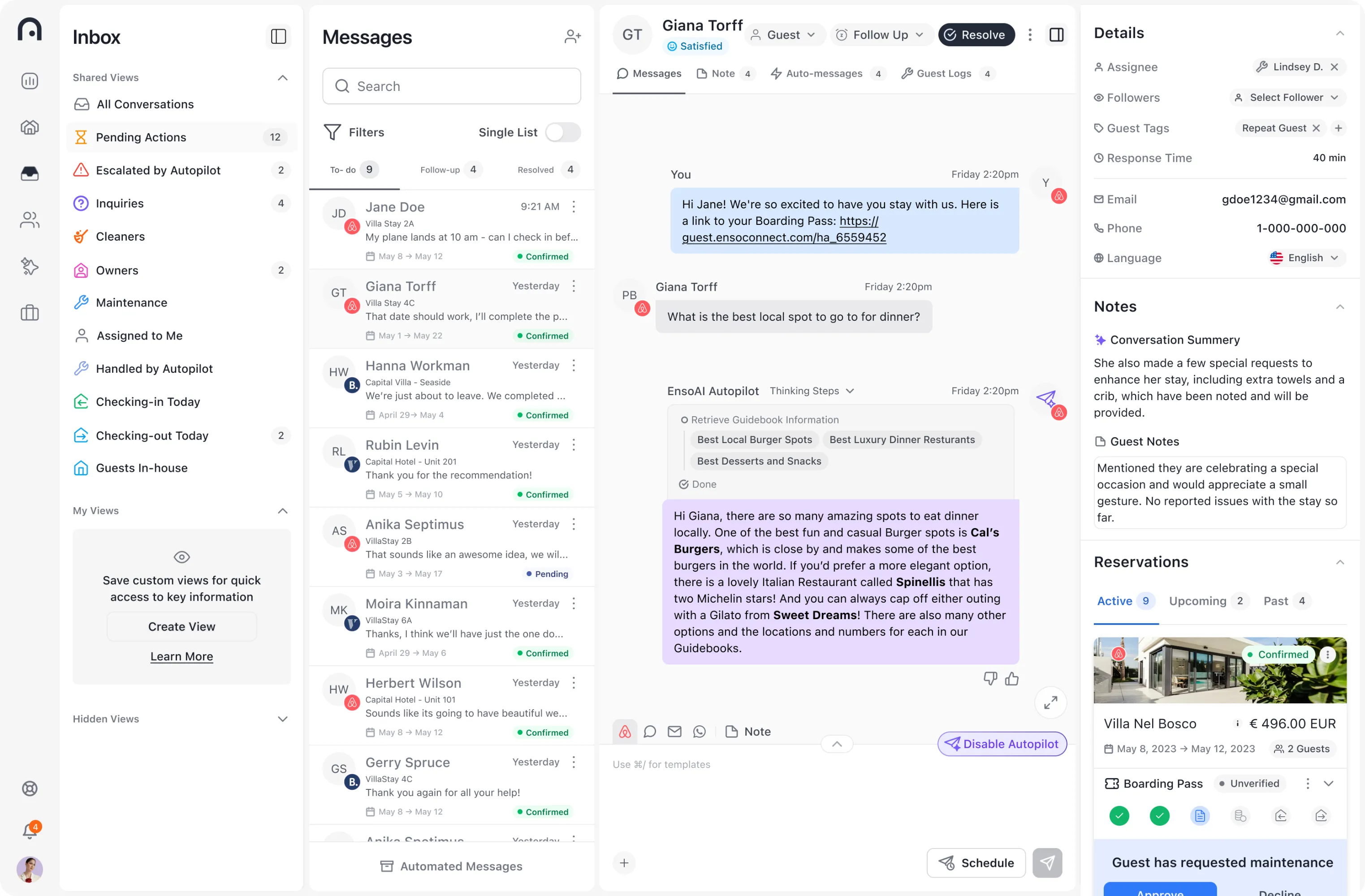
The Enso Connect Boarding Pass as the way guests access their stay is still allowed.
Airbnb's new text lets hosts offer keyless entry apps that require registration, as long as they provide an alternate access method if the guest asks. Optional apps that improve the stay, like concierge apps, are explicitly fine.
That alternative is already covered on Enso. If an Airbnb guest does not want to use Boarding Pass, EnsoAI can send them their access instructions directly in the Airbnb conversation. No separate account, no download, no form. The guest gets in either way, and the operator keeps the experience they built for everyone who opts in.
What matters is that Boarding Pass is offered, not forced. Guides, house manuals, upsells and local recommendations all stay, because guests choose to use them.
What changes: rental agreements
For most Airbnb short stays, the rental agreement step in Enso Connect's Boarding Pass has to come off. Under the new policy, a host can only require a separate contract in four cases:
A law or community association rule requires it, such as an HOA or building security rule
It covers an optional amenity, like a golf cart or boat rental
The stay is 28 nights or more
The listing is on Airbnb Luxe
Even then, the contract must be uploaded to the listing's contract section, where it is publicly visible, so it cannot contain personal information. Airbnb can ask for evidence that the contract qualifies, and it does not require guests to sign or help enforce it.
For Enso operators, that means the agreement step should only show on Airbnb bookings that meet one of these cases. Optional amenity agreements, like a waiver attached to a bike or kayak upsell, can still be signed in Boarding Pass because the guest chooses to buy the amenity, as long as the contract is also disclosed on the listing.
What changes: ID checks
Required ID uploads and selfie verification in Boarding Pass can no longer be the default for Airbnb bookings. The new policy bars hosts from collecting passports, driver's licences, ID photos or facial recognition data at any point in the booking or stay.
There are two exceptions where collection is still allowed:
A law requires it. Guest registration rules in much of Europe, for example, require operators to record traveller details. Operators can collect exactly what the law requires, and nothing more.
A documented HOA or building rule requires it. Keep the written rule on file, since Airbnb may ask for it.
In both cases the listing's requests section must say what is collected and why, so the guest sees it before booking. Reasons like insurance or general security no longer fit the exceptions on their own.
Outside those cases, the operator's options are to check ID in person at check in, disclosed on the listing with no copy kept, or to rely on Airbnb's own verification of the booking guest. For remote operations with no one at the door, Airbnb's verification becomes the default.
What stays the same: deposits, damage waivers and upsells
Money was mostly left out of this update.
Security deposits and mandatory damage waivers. Hosts connected through approved software, like Enso Connect, can still require one using Airbnb's offline fees feature. It shows on the listing and in the price breakdown before the guest books, and Enso collects it through Boarding Pass. A deposit has to be fully released within 7 days of checkout if there's no damage.
Optional damage waivers. These can be offered in Boarding Pass after booking, like any other extra. If one needs a signature, it falls under the optional amenity contract case, so disclose it on the listing too.
Upsells. Early check in, late checkout and other extras are still fine, as long as access never depends on buying them. If a partner pays you a commission, or you own the business you recommend, tell the guest. A line like "We may earn a commission when you book through this link" does the job.
Some operators are also offering guests three choices: pay a deposit, buy a waiver, or skip both and accept responsibility for damage. That's close to truly optional, since skipping is effectively the default on Airbnb anyway. It should hold up as long as skipping doesn't require a signature and access doesn't unlock only after the guest picks. Asking guests to choose between a deposit and a waiver, with no way to skip, makes it mandatory, so it belongs in offline fees.
Gray areas we're confirming with Airbnb
Two parts of the policy still leave room for interpretation, and we're working through them with our partnership team at Airbnb:
What counts as "law" for ID collection. City and country registration rules clearly count. Owner insurance requirements likely don't, since Airbnb removed the old "legal or compliance" wording. The question that remains unanswered: if you are a property manager and your owner's insurance policy requires ID collection to list on short term rental platforms like Airbnb, does that inventory get removed from Airbnb?
What counts as "law" for rental agreements. Same question. Jurisdictions that require a written rental contract clearly count. If an owner's insurance policy requires a signed agreement to list on short term rental platforms like Airbnb, does that inventory have to come off Airbnb?
We'll update this post as we hear back.
What Enso is doing, and what to do before November 20
We are updating Enso Connect's Boarding Pass so Airbnb bookings made from November 20 skip the agreement and ID steps unless one of Airbnb's exceptions applies. Bookings from direct, Vrbo and other channels are not affected by this policy.
Our team will reach out to help each account set this up.
In the meantime, operators should:
List which properties have a legal registration requirement or a written HOA or building rule, and keep the documents
Add a clear line to the requests section of those Airbnb listings saying what is collected and why
Decide which agreements qualify (optional amenities, 28+ night stays, Luxe) and upload them to the listing's contract section
Remove agreement and ID requirements from Airbnb messages and guidebooks for everything else
Turn off phone and email capture, and any WiFi portal asking Airbnb guests for personal info
Move any mandatory deposit or damage waiver to Airbnb's offline fees
Add a commission disclosure to partner upsells
Remove checkout chores and fines from house rules
Airbnb is pushing the whole industry toward a simpler arrival. Boarding Pass and EnsoAI were built for exactly that: an easy way in, the information guests need, and everything else optional.