
The hospitality technology industry talks about "AI-native" software like it's a feature checkbox. Add a chatbot. Bolt on some automation. Ship an update.
Most property management software remains fundamentally static — fixed screens, fixed features, one-size-fits-all configurations. The same platform is supposed to serve a single-unit Airbnb host in Austin and a 500-property enterprise managing long-term, mid-term, and short-term rentals across three continents. It can't. No amount of AI chatbots bolted onto a legacy architecture will fix that.
The Frankensoftware Problem
Mature B2B SaaS in the short-term rental space has a characteristic look: infinite sidebar navigation, fifteen pages within single sections, nested menus, and features consuming screen real estate that 90% of users will never touch. Workflow builders require expert-level configuration. With AI, the complexity multiplies: more configuration panels, more toggles, more buried "AI settings" that most operators never find.
Onboarding takes months — not because operators are slow, but because the software is bloated with features designed for every possible use case, which means it's optimized for none of them. The platforms that were supposed to simplify operations have instead created a new category of complexity that requires its own management.
The deeper problem: when one platform can only solve a narrow slice of operational needs, operators duct-tape five platforms together — each "best in class" at something, none communicating properly with the others. The result is a fragmented data environment where every integration point is a potential failure, and where your team spends more time managing tools than managing guests.
The Diversity Problem Nobody Talks About
Short-term rental operators aren't monolithic. The category includes vacation rental hosts alongside long-term property managers alongside hybrid portfolio operators; single hosts alongside multi-brand enterprises; offshore teams alongside in-house operations alongside fully outsourced management. Operators managing 5 properties have fundamentally different needs than operators managing 500.
Each segment has different workflows, different reporting requirements, different team structures, and different integration needs. A static software platform that tries to serve all of them ends up serving none particularly well.
This is the core failure mode of traditional property management software: one-size-fits-all means nothing-fits-anyone.
What AI-Native Actually Means
The future of hospitality technology isn't smarter static software. It's software that adapts to your operation rather than forcing your operation to adapt to it.
Think of it this way: traditional software ships a changelog — one set of features for all customers. True AI-native architecture effectively runs a different changelog for every customer. Your operation gets the workflows, automations, and interfaces that match your specific context, scale, and team structure. A solo operator managing 20 properties gets a streamlined experience. An enterprise with regional managers and multiple brands gets a different configuration entirely.
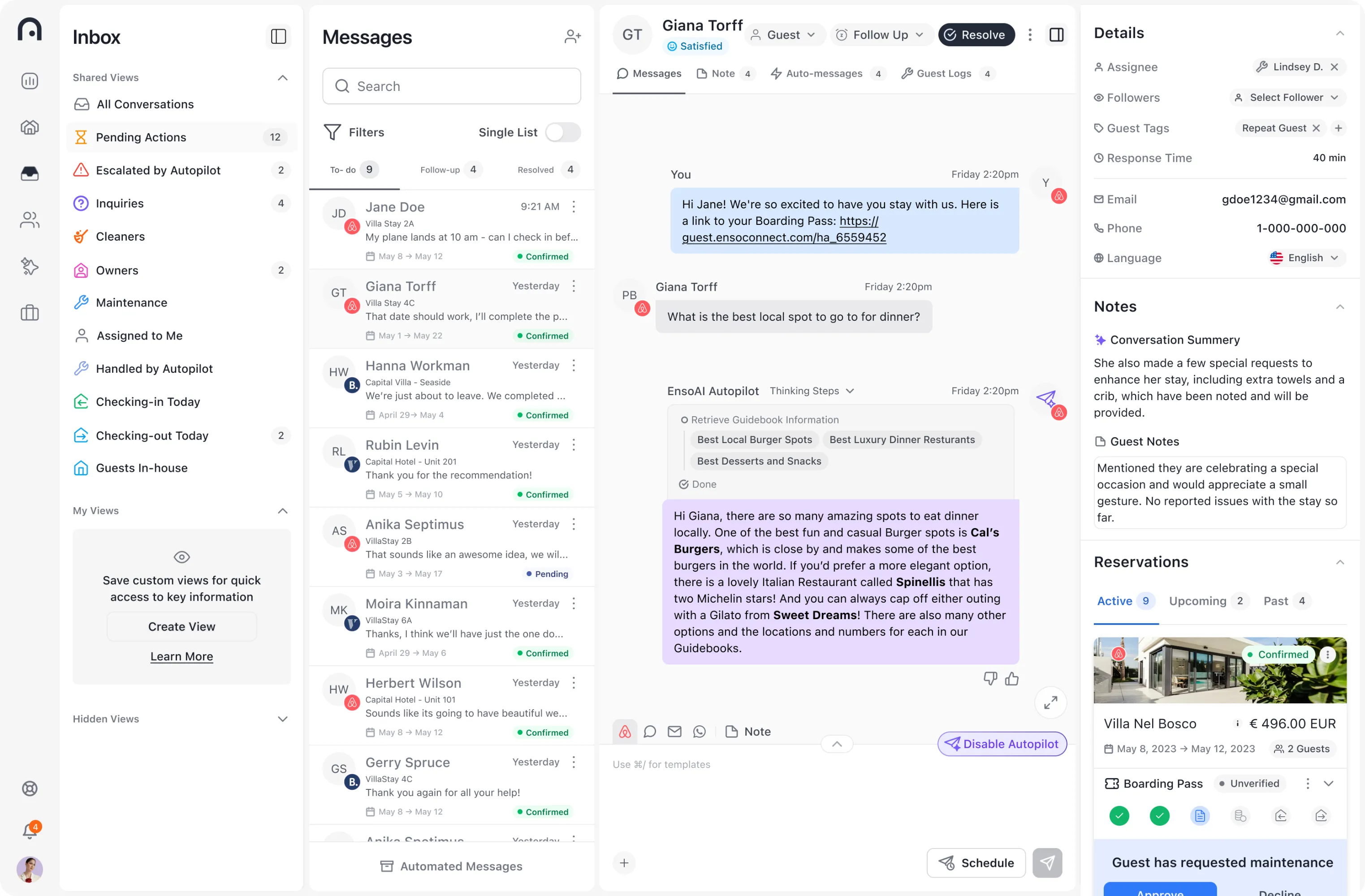
Enso Connect is built on this model. The core platform provides the stable infrastructure: unified inbox, guest automation, boarding pass, upsell engine, guest verification. The adaptive layer — your automation flows, your messaging templates, your escalation rules, your upsell pricing — configures itself around how your operation actually works.
Three Tests for AI-Native STR Software
If you're evaluating platforms today, three signals distinguish genuine AI-native architecture from legacy software with an AI wrapper:
Can you interact with every part of the platform through AI? If you can only chat with AI in one section while the rest requires menu navigation, it's not AI-native. It's a chatbot taped onto legacy infrastructure.
Does the platform adapt to your operation, or does your operation adapt to the platform? Traditional software forces you into its workflow model. AI-native software learns your patterns and configures itself around them.
Does the interface evolve based on what you actually do? The most advanced systems surface what you need when you need it, rather than presenting the same static dashboard to every user regardless of their role or current task.
The Consolidation Moment
The short-term rental technology landscape is consolidating. The 15-tool tech stack — a PMS here, a messaging tool there, a guidebook platform, a damage waiver provider, a noise monitor, an access control system — is becoming operationally unsustainable as portfolios scale.
Operators who manage 50+ properties can no longer afford the overhead of managing integrations, reconciling data across systems, and training staff on multiple platforms. The pressure is toward fewer, more capable tools that share data natively.
Enso Connect sits at the center of this consolidation as the guest experience and automation layer: the platform where every guest interaction flows, every upsell gets tracked, every check-in gets managed, and every communication goes out. It connects to your PMS rather than replacing it, adding the guest-facing intelligence that most PMSs lack.
From Feature Requests to Adaptive Configuration
The traditional software model treats operators as passive recipients of the vendor's product roadmap. You submit feature requests. You wait six months. You get a feature that was designed for the average of all customers, which means it doesn't work perfectly for any of them.
Enso Connect's approach inverts this. The platform's automation engine learns from how you configure it. Common patterns across the customer base inform improvements that ship to everyone. But your specific workflows, your messaging voice, your upsell pricing — those stay customized to your operation without requiring a professional services engagement to set up.
The software grows around the business, not the other way around.
The Bottom Line for STR Operators
If your current property management software requires months to onboard, feels bloated with features you don't use, forces you to maintain five integrations to cover basic operational needs, and still doesn't quite fit how your team works — you're experiencing the limitations of static SaaS in an AI era.
The operators who will thrive in the next phase of the short-term rental market are those who build on platforms designed to adapt: fewer tools, deeper integration, automation that learns from your operation rather than forcing it into a predetermined mold.
Talk to Enso Connect about what an AI-native guest experience platform looks like for your portfolio.