Before You Buy an STR Chatbot: 5 Things Operators Miss
Discover why chatbots underdeliver for vacation rentals and what to look for in AI that actually reduces messages and increases revenue.
20 de enero de 2026


Why Context-Aware AI Matters for Vacation Rentals
If you're a short-term rental host or property manager, you've likely considered AI-powered solutions to reduce guest messages and improve satisfaction. But here's what most property owners discover too late: without context about where guests are in their journey, chatbots underdeliver.
The promise of artificial intelligence is appealing - instant responses, automation tools that save time, and the ability to handle common questions without manual intervention. However, the reality often falls short when AI systems lack the guest journey context they need to be truly effective.
Choosing an AI Chatbot for Your Rental: What to Know
Chatbots answer questions but don't prevent them
AI without context risks wrong answers
Context-aware AI helps guests, not frustrates them
AI unlocks revenue when it's part of the guest journey
AI must sync with your guest system to stay current
Let's dive into the 5 things you need to consider before choosing an AI chatbot solution.
1. A Chatbot Answers Questions - It Doesn't Prevent Them
Why Answering Faster Doesn't Mean Fewer Messages
Most vacation rental operators and Airbnb hosts buy AI hoping to reduce their inbox volume. But here's the problem: reactive chatbots can only respond to questions - they can't prevent them from happening in the first place.
Think of it this way: a traditional AI assistant waits for guests to ask a simple question, then provides instant answers. While that sounds like a powerful tool, you're still spending just as much time managing guest interaction. You've simply automated the response, not eliminated the need for it.
The Difference: Reactive AI vs. Proactive Guest Experience
AI-Only Chatbot (Reactive Approach) | AI + Guest Journey (Proactive Approach) |
|---|---|
✗ Guests must ask first | ✓ Info delivered before guests need to ask |
✗ Same questions repeat daily | ✓ Check-in, Wi-Fi, parking sent automatically |
✗ Faster replies, same volume | ✓ Fewer questions, fewer interruptions |
✗ More messages = more errors | ✓ Inbox volume drops |
Result: You reply quicker - but the inbox stays busy. | Result: The best guest question is the one that never arrives. |
What Guests Keep Asking
Every property manager knows these recurring questions:
"What's the Wi-Fi?"
"How do I get in?"
"Where do I park?"
These common questions eat up valuable time that could be spent on revenue management, improving your rental properties or solving critical situations. It's important to understand that generic AI models can answer these queries, but they can't stop them from arriving in the first place.
What Actually Works
Instead of waiting for guests to ask, implement:
Automated check-in instructions sent before arrival
Visual access guides and directions delivered en route
House rules shared upfront via your guest app
This proactive approach represents best practices in guest communication for the rental management industry.
Real Scenario: A professional property management company reduced repetitive questions by 90% by providing essential information before guests ask.
"I get 90% fewer calls about Wi-Fi, check-in instructions, and house manuals."
- Chris Naylor, Vacation Specialist / Guest Relations, Durango Colorado Vacations
Takeaway #1: A chatbot answers questions. A guest experience system prevents them.
2. AI Without Context Can't Be Trusted
It Doesn't Know Who the Guests Are, Or Where They Are in the Guest Journey
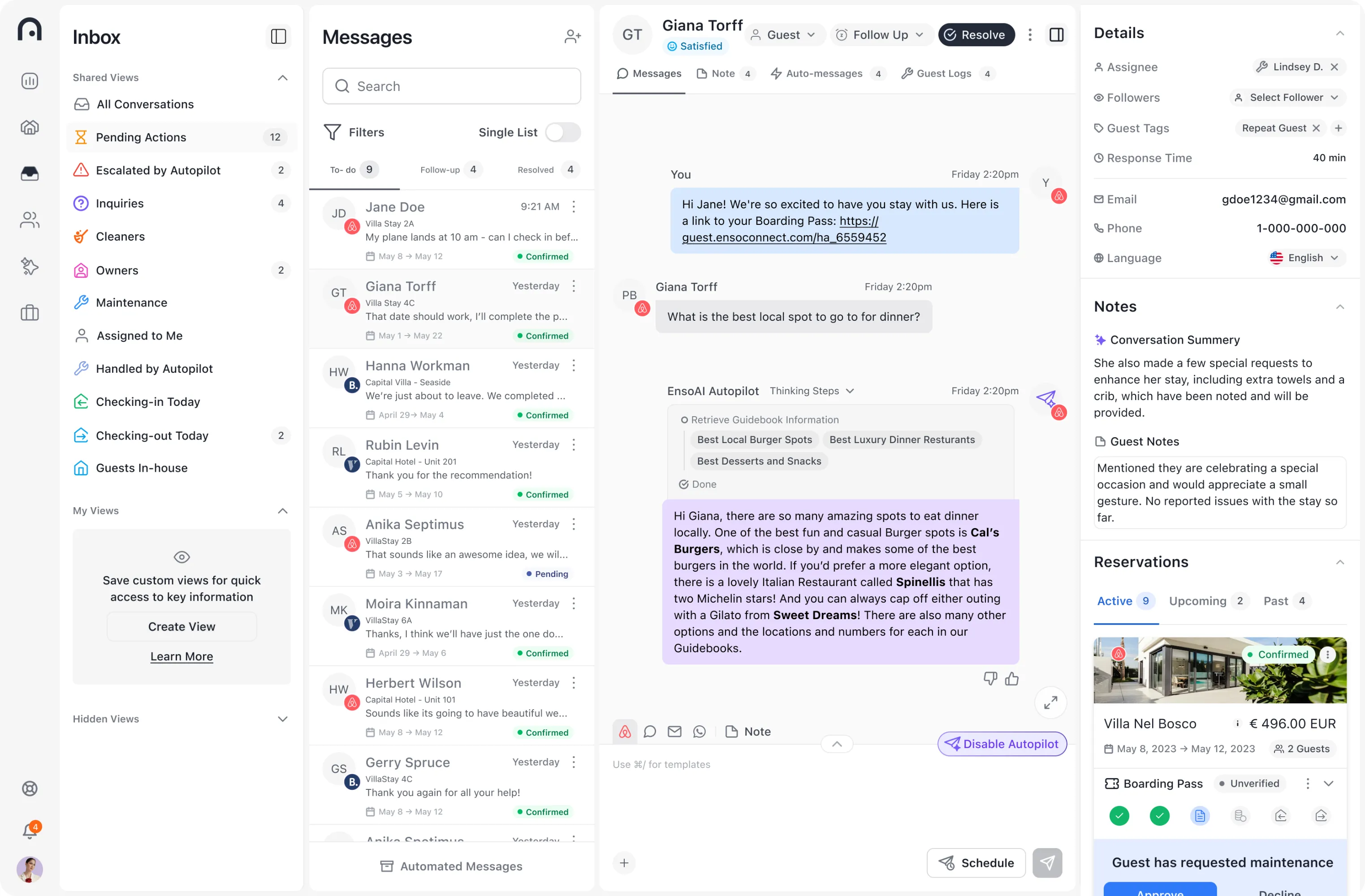
Guest context is critical for accurate, safe AI responses. Even the most advanced AI models and large language models struggle when they lack context. In hospitality operations, the relevant context would be booking status, verification completion, check-in timing, etc.
This is where many rental managers encounter potential risks. Without proper integration with your guest experience tools and a property management system (PMS), AI can become a liability rather than an asset.
The Context Problem
AI Without Context: | AI With Guest Context: |
|---|---|
✗ Doesn't know guest status | ✓ Knows if agreement is signed |
✗ Doesn't know timing | ✓ Knows check-in date & time |
✗ Doesn't know permissions | ✓ Knows what the guest has seen |
✗ Risks wrong answers | ✓ Responds safely and accurately |
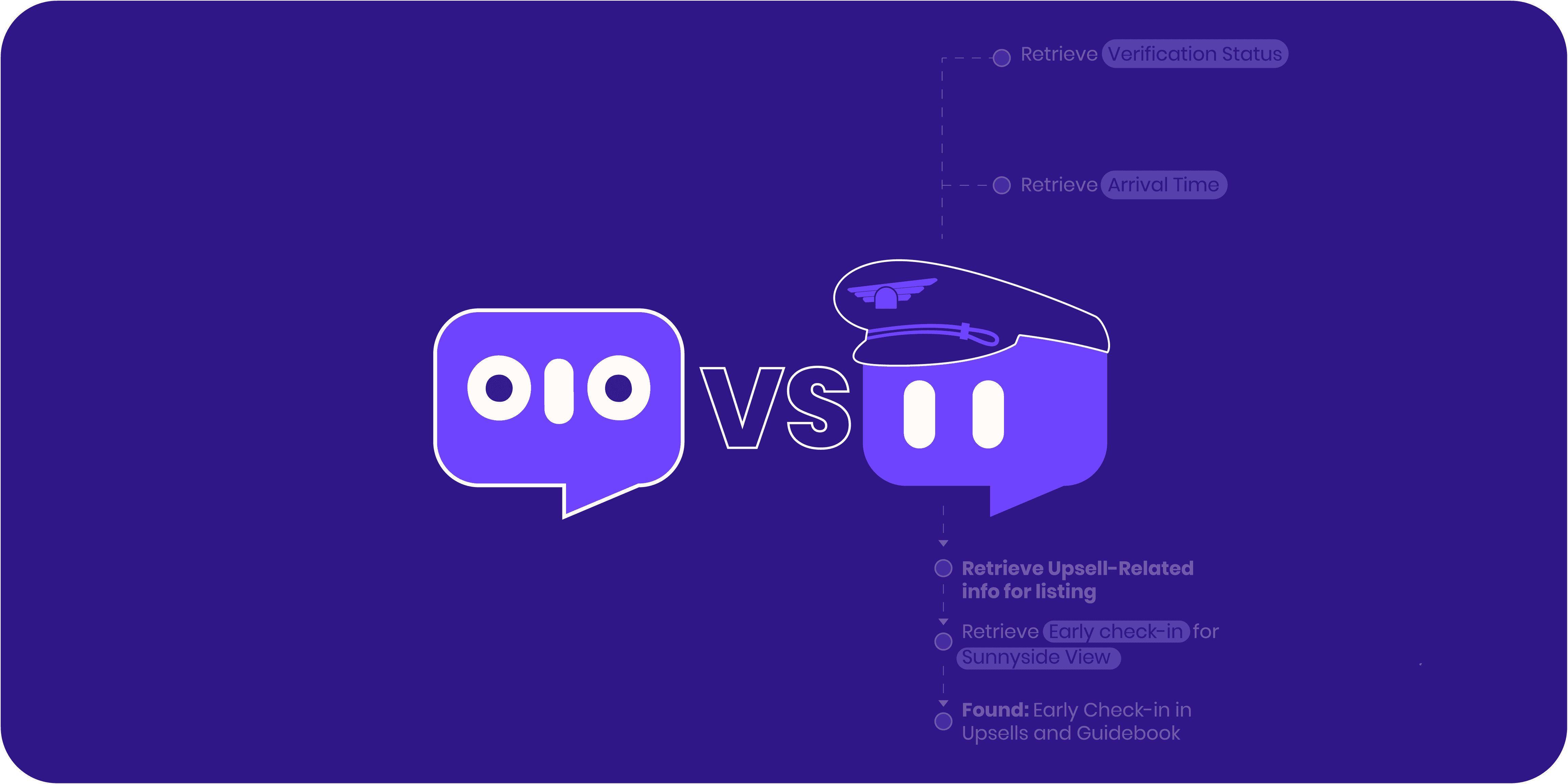
Real Scenario: The Door Code Problem
A guest asks for the door code, but hasn't signed the rental agreement yet.
Generic AI: Guesses or provides the code anyway (security risk!)
Context-aware AI: If the guest hasn't completed the verification step, AI will flag this and escalate to a human or follow the procedure for such cases, if defined in the policies. In this case, it responds correctly based on guest status and delivers relevant information only when appropriate.
This demonstrates why an AI-powered solution must have complete control over what information gets shared and when, and be able to follow pre-defined instructions or escalate to a human.
Result: Safer, more accurate responses — without slowing down or risking mistakes.
"EnsoAI's replies have been consistently spot-on."
— Fédéric Schurch, Head of Sales, Pinarello Villa Services
Takeaway #2: Context isn't optional. It's what makes AI usable.
3. Chatbots Are Reactive - Guests Don't Want to Message You
They Want Things to Just Work
Here's the uncomfortable truth: if guests message you, it's usually a symptom of missing information. Most hosts agree that when guests don't message them, it signifies high guest satisfaction.
In the travel industry, guests expect seamless experiences similar to what they get from major travel companies and booking platforms. They don't want to feel like they're bothering you with questions - they want information to appear naturally as they need it.
Reactive vs. Proactive AI Strategy
Reactive AI: | Proactive Guest Experience: |
|---|---|
✗ Waits for the guest to ask | ✓ Anticipates needs |
✗ Inbox-first approach | ✓ Journey-first approach |
✗ Solves symptoms only | ✓ Prevents issues |
This shift from reactive to proactive represents a competitive advantage for short-term rental hosts who implement it correctly.
Proactive Guest Experience in Action

Rather than waiting for guests to reach out through various communication channels, smart AI agents can:
Send timely checkups about arrival
Present relevant offers at the right moment
Deliver reminders automatically, without a need to message manually
The best AI chatbot for rental properties isn't necessarily the one with the fastest model or most advanced features, it's the one that prevents guests from needing to ask questions in the first place.
Result: Fewer interruptions, fewer complaints, better reviews.
Takeaway #3: AI should follow the guest journey, not live inside the inbox.
4. Reactive AI Doesn't Unlock Revenue
It Comes From Timing, Placement, and Context
Want to generate revenue from your AI investment? Here's what most operators miss: AI alone can't create upsell opportunities. Revenue comes from presenting the right offer at the right moment in the guest journey.
Many property owners invest in automation tools expecting immediate financial returns, only to find that their AI assistant can answer questions but doesn't actually drive bookings or upsells. The difference lies in integration and timing.
How AI Fails (and Succeeds) at Revenue Generation
AI Alone: | AI Embedded in the Stay: |
|---|---|
✗ Upsells only if guests ask | ✓ Upsell offers timed to the stay |
✗ Poor timing | ✓ Visual presentation |
✗ Text-based offers | ✓ Embedded naturally in the guest journey |
Think of this like dynamic pricing for guest services. Just as you adjust rates based on market demand and historical data, your AI-powered tool should adjust what it offers based on where guests are in their trip planning and stay.
Revenue Opportunities at the Right Moment
Early check-in (when guests are traveling)
Late checkout (during the stay)
Add-ons & extras (contextual to guest needs)
These use cases show how AI systems can create better results when they're part of the overall guest experience rather than just a messaging interface.
Real Scenario: An AI-Powered guest experience platform delivers a real incremental revenue, covering its cost.
"Enso paid for itself in 28 days."
- Njål Eliasson, Founder, DigiHome (former Heimby)
Takeaway #4: AI creates revenue only when it's part of the guest journey.
5. Accuracy Isn't a One-Time Setup
Information Changes Constantly - AI Must Too
The biggest mistake property managers make is treating AI training as a one-time setup. Your property information, policies, and processes evolve constantly. Your AI needs to evolve with them.
Unlike static automation tools, modern AI agents powered by machine learning and natural language processing can continuously improve. But they stay current only if they're connected to your live systems in real time.
Static vs. Continuously Learning AI
Static AI: | Continuously Trained AI: |
|---|---|
✗ Trained once | ✓ Learns from live content |
✗ Errors repeat | ✓ One source of truth |
✗ Teams lose trust | ✓ Finds and fixes conflicts in your content |
This continuous learning approach gives rental managers the service quality they need without requiring constant manual updates. It's the difference between doing all the heavy lifting yourself and having AI that actually adapts to your evolving operations.
Information That Needs Continuous Updates
Access instructions (locks, codes, entry processes)
House rules (seasonal changes, new policies)
Wi-Fi & amenities info (network changes, upgrades)
Seasonal policies (winter vs. summer rules)
Your standard operating procedures (SOPs) (operational changes)
For Airbnb hosts and rental managers juggling multiple rental properties across different online listings, keeping all this information synchronized manually simply isn't scalable. AI that syncs with your property management system solves this challenge.
Real Scenario: Higher accuracy, stronger trust, automation that actually scales.
"The AI keeps learning — now it delivers nearly perfect replies."
- Frank de la Fuente, Deputy Director of Operations, Waou Rentals
Takeaway #5: AI must sync with your guest system to stay current.
Conclusion: Choose AI That Works With Your Guest Journey
Most short-term rental operators buy chatbots expecting reduced workload and improved guest satisfaction. But as we've seen, generic chatbots without context and guest journey integration can underdeliver.
The near future of rental management isn't about replacing the personal touch with artificial intelligence; it's about using AI solutions to enhance guest communication while freeing up your time for what matters most.
Before You Choose an AI Solution, Remember:
Prevention > Reaction: Choose systems that prevent questions, not just answer them
Context is critical: AI needs to know guest status, timing, and journey stage
Proactive beats reactive: Follow the guest journey, don't just monitor the inbox
Revenue needs timing: Upsells only work when embedded in the guest experience
Continuous learning matters: Your AI must sync with your guest system to stay accurate
When implemented correctly, these AI systems become a powerful tool that delivers instant responses while maintaining the quality guest interaction that drives positive Airbnb guest reviews and repeat bookings.
See How Context-Driven AI Reduces Messages and Unlocks Revenue
Ready to implement AI that actually delivers on its promises? See it live
FAQs About AI Chatbots for Short-Term Rentals
Q: What's the difference between a chatbot and an AI guest experience system? | A: A chatbot reacts to guest questions with instant answers. An AI guest experience system proactively delivers relevant information before guests need to ask, reducing message volume by up to 90%, automating the rest and freeing up the time to take care of the cases that require human care. |
Q: Why does AI need guest context? | A: Without knowing who the guest is, their booking status, or where they are in their journey (booked, verified, checked in, etc.), even advanced AI models risk providing wrong or unsafe answers. Context ensures your AI assistant delivers accurate, timely information. |
Q: Can AI really generate revenue for vacation rentals? | A: Yes, but only when integrated into the guest journey. AI needs to present offers (early check-in, late checkout, add-ons) at the right moment with proper timing and visual presentation, similar to how dynamic pricing adjusts based on market demand. |
Q: How often should AI be updated? | A: Operators report 90% fewer repetitive questions, significantly improved customer experience, and revenue generation that often covers the platform cost within 30 days. For many rental managers, this represents a clear competitive advantage in the crowded short-term rental market. |
Q: What's the ROI of context-aware AI? | A: Operators report 90% fewer repetitive questions, significantly improved customer experience, and revenue generation that often covers the platform cost within 30 days. For many rental managers, this represents a clear competitive advantage in the crowded short-term rental market. |
Q: Will AI replace the personal touch in guest communication? | A: No. The best AI-powered solutions enhance rather than replace human interaction. They handle common questions and routine communication channels while freeing you to focus on complex guest needs and building relationships that drive better results. |
Why Context-Aware AI Matters for Vacation Rentals
If you're a short-term rental host or property manager, you've likely considered AI-powered solutions to reduce guest messages and improve satisfaction. But here's what most property owners discover too late: without context about where guests are in their journey, chatbots underdeliver.
The promise of artificial intelligence is appealing - instant responses, automation tools that save time, and the ability to handle common questions without manual intervention. However, the reality often falls short when AI systems lack the guest journey context they need to be truly effective.
Choosing an AI Chatbot for Your Rental: What to Know
Chatbots answer questions but don't prevent them
AI without context risks wrong answers
Context-aware AI helps guests, not frustrates them
AI unlocks revenue when it's part of the guest journey
AI must sync with your guest system to stay current
Let's dive into the 5 things you need to consider before choosing an AI chatbot solution.
1. A Chatbot Answers Questions - It Doesn't Prevent Them
Why Answering Faster Doesn't Mean Fewer Messages
Most vacation rental operators and Airbnb hosts buy AI hoping to reduce their inbox volume. But here's the problem: reactive chatbots can only respond to questions - they can't prevent them from happening in the first place.
Think of it this way: a traditional AI assistant waits for guests to ask a simple question, then provides instant answers. While that sounds like a powerful tool, you're still spending just as much time managing guest interaction. You've simply automated the response, not eliminated the need for it.
The Difference: Reactive AI vs. Proactive Guest Experience
AI-Only Chatbot (Reactive Approach) | AI + Guest Journey (Proactive Approach) |
|---|---|
✗ Guests must ask first | ✓ Info delivered before guests need to ask |
✗ Same questions repeat daily | ✓ Check-in, Wi-Fi, parking sent automatically |
✗ Faster replies, same volume | ✓ Fewer questions, fewer interruptions |
✗ More messages = more errors | ✓ Inbox volume drops |
Result: You reply quicker - but the inbox stays busy. | Result: The best guest question is the one that never arrives. |
What Guests Keep Asking
Every property manager knows these recurring questions:
"What's the Wi-Fi?"
"How do I get in?"
"Where do I park?"
These common questions eat up valuable time that could be spent on revenue management, improving your rental properties or solving critical situations. It's important to understand that generic AI models can answer these queries, but they can't stop them from arriving in the first place.
What Actually Works
Instead of waiting for guests to ask, implement:
Automated check-in instructions sent before arrival
Visual access guides and directions delivered en route
House rules shared upfront via your guest app
This proactive approach represents best practices in guest communication for the rental management industry.
Real Scenario: A professional property management company reduced repetitive questions by 90% by providing essential information before guests ask.
"I get 90% fewer calls about Wi-Fi, check-in instructions, and house manuals."
- Chris Naylor, Vacation Specialist / Guest Relations, Durango Colorado Vacations
Takeaway #1: A chatbot answers questions. A guest experience system prevents them.
2. AI Without Context Can't Be Trusted
It Doesn't Know Who the Guests Are, Or Where They Are in the Guest Journey
Guest context is critical for accurate, safe AI responses. Even the most advanced AI models and large language models struggle when they lack context. In hospitality operations, the relevant context would be booking status, verification completion, check-in timing, etc.
This is where many rental managers encounter potential risks. Without proper integration with your guest experience tools and a property management system (PMS), AI can become a liability rather than an asset.
The Context Problem
AI Without Context: | AI With Guest Context: |
|---|---|
✗ Doesn't know guest status | ✓ Knows if agreement is signed |
✗ Doesn't know timing | ✓ Knows check-in date & time |
✗ Doesn't know permissions | ✓ Knows what the guest has seen |
✗ Risks wrong answers | ✓ Responds safely and accurately |
Real Scenario: The Door Code Problem
A guest asks for the door code, but hasn't signed the rental agreement yet.
Generic AI: Guesses or provides the code anyway (security risk!)
Context-aware AI: If the guest hasn't completed the verification step, AI will flag this and escalate to a human or follow the procedure for such cases, if defined in the policies. In this case, it responds correctly based on guest status and delivers relevant information only when appropriate.
This demonstrates why an AI-powered solution must have complete control over what information gets shared and when, and be able to follow pre-defined instructions or escalate to a human.
Result: Safer, more accurate responses — without slowing down or risking mistakes.
"EnsoAI's replies have been consistently spot-on."
— Fédéric Schurch, Head of Sales, Pinarello Villa Services
Takeaway #2: Context isn't optional. It's what makes AI usable.
3. Chatbots Are Reactive - Guests Don't Want to Message You
They Want Things to Just Work
Here's the uncomfortable truth: if guests message you, it's usually a symptom of missing information. Most hosts agree that when guests don't message them, it signifies high guest satisfaction.
In the travel industry, guests expect seamless experiences similar to what they get from major travel companies and booking platforms. They don't want to feel like they're bothering you with questions - they want information to appear naturally as they need it.
Reactive vs. Proactive AI Strategy
Reactive AI: | Proactive Guest Experience: |
|---|---|
✗ Waits for the guest to ask | ✓ Anticipates needs |
✗ Inbox-first approach | ✓ Journey-first approach |
✗ Solves symptoms only | ✓ Prevents issues |
This shift from reactive to proactive represents a competitive advantage for short-term rental hosts who implement it correctly.
Proactive Guest Experience in Action

Rather than waiting for guests to reach out through various communication channels, smart AI agents can:
Send timely checkups about arrival
Present relevant offers at the right moment
Deliver reminders automatically, without a need to message manually
The best AI chatbot for rental properties isn't necessarily the one with the fastest model or most advanced features, it's the one that prevents guests from needing to ask questions in the first place.
Result: Fewer interruptions, fewer complaints, better reviews.
Takeaway #3: AI should follow the guest journey, not live inside the inbox.
4. Reactive AI Doesn't Unlock Revenue
It Comes From Timing, Placement, and Context
Want to generate revenue from your AI investment? Here's what most operators miss: AI alone can't create upsell opportunities. Revenue comes from presenting the right offer at the right moment in the guest journey.
Many property owners invest in automation tools expecting immediate financial returns, only to find that their AI assistant can answer questions but doesn't actually drive bookings or upsells. The difference lies in integration and timing.
How AI Fails (and Succeeds) at Revenue Generation
AI Alone: | AI Embedded in the Stay: |
|---|---|
✗ Upsells only if guests ask | ✓ Upsell offers timed to the stay |
✗ Poor timing | ✓ Visual presentation |
✗ Text-based offers | ✓ Embedded naturally in the guest journey |
Think of this like dynamic pricing for guest services. Just as you adjust rates based on market demand and historical data, your AI-powered tool should adjust what it offers based on where guests are in their trip planning and stay.
Revenue Opportunities at the Right Moment
Early check-in (when guests are traveling)
Late checkout (during the stay)
Add-ons & extras (contextual to guest needs)
These use cases show how AI systems can create better results when they're part of the overall guest experience rather than just a messaging interface.
Real Scenario: An AI-Powered guest experience platform delivers a real incremental revenue, covering its cost.
"Enso paid for itself in 28 days."
- Njål Eliasson, Founder, DigiHome (former Heimby)
Takeaway #4: AI creates revenue only when it's part of the guest journey.
5. Accuracy Isn't a One-Time Setup
Information Changes Constantly - AI Must Too
The biggest mistake property managers make is treating AI training as a one-time setup. Your property information, policies, and processes evolve constantly. Your AI needs to evolve with them.
Unlike static automation tools, modern AI agents powered by machine learning and natural language processing can continuously improve. But they stay current only if they're connected to your live systems in real time.
Static vs. Continuously Learning AI
Static AI: | Continuously Trained AI: |
|---|---|
✗ Trained once | ✓ Learns from live content |
✗ Errors repeat | ✓ One source of truth |
✗ Teams lose trust | ✓ Finds and fixes conflicts in your content |
This continuous learning approach gives rental managers the service quality they need without requiring constant manual updates. It's the difference between doing all the heavy lifting yourself and having AI that actually adapts to your evolving operations.
Information That Needs Continuous Updates
Access instructions (locks, codes, entry processes)
House rules (seasonal changes, new policies)
Wi-Fi & amenities info (network changes, upgrades)
Seasonal policies (winter vs. summer rules)
Your standard operating procedures (SOPs) (operational changes)
For Airbnb hosts and rental managers juggling multiple rental properties across different online listings, keeping all this information synchronized manually simply isn't scalable. AI that syncs with your property management system solves this challenge.
Real Scenario: Higher accuracy, stronger trust, automation that actually scales.
"The AI keeps learning — now it delivers nearly perfect replies."
- Frank de la Fuente, Deputy Director of Operations, Waou Rentals
Takeaway #5: AI must sync with your guest system to stay current.
Conclusion: Choose AI That Works With Your Guest Journey
Most short-term rental operators buy chatbots expecting reduced workload and improved guest satisfaction. But as we've seen, generic chatbots without context and guest journey integration can underdeliver.
The near future of rental management isn't about replacing the personal touch with artificial intelligence; it's about using AI solutions to enhance guest communication while freeing up your time for what matters most.
Before You Choose an AI Solution, Remember:
Prevention > Reaction: Choose systems that prevent questions, not just answer them
Context is critical: AI needs to know guest status, timing, and journey stage
Proactive beats reactive: Follow the guest journey, don't just monitor the inbox
Revenue needs timing: Upsells only work when embedded in the guest experience
Continuous learning matters: Your AI must sync with your guest system to stay accurate
When implemented correctly, these AI systems become a powerful tool that delivers instant responses while maintaining the quality guest interaction that drives positive Airbnb guest reviews and repeat bookings.
See How Context-Driven AI Reduces Messages and Unlocks Revenue
Ready to implement AI that actually delivers on its promises? See it live
FAQs About AI Chatbots for Short-Term Rentals
Q: What's the difference between a chatbot and an AI guest experience system? | A: A chatbot reacts to guest questions with instant answers. An AI guest experience system proactively delivers relevant information before guests need to ask, reducing message volume by up to 90%, automating the rest and freeing up the time to take care of the cases that require human care. |
Q: Why does AI need guest context? | A: Without knowing who the guest is, their booking status, or where they are in their journey (booked, verified, checked in, etc.), even advanced AI models risk providing wrong or unsafe answers. Context ensures your AI assistant delivers accurate, timely information. |
Q: Can AI really generate revenue for vacation rentals? | A: Yes, but only when integrated into the guest journey. AI needs to present offers (early check-in, late checkout, add-ons) at the right moment with proper timing and visual presentation, similar to how dynamic pricing adjusts based on market demand. |
Q: How often should AI be updated? | A: Operators report 90% fewer repetitive questions, significantly improved customer experience, and revenue generation that often covers the platform cost within 30 days. For many rental managers, this represents a clear competitive advantage in the crowded short-term rental market. |
Q: What's the ROI of context-aware AI? | A: Operators report 90% fewer repetitive questions, significantly improved customer experience, and revenue generation that often covers the platform cost within 30 days. For many rental managers, this represents a clear competitive advantage in the crowded short-term rental market. |
Q: Will AI replace the personal touch in guest communication? | A: No. The best AI-powered solutions enhance rather than replace human interaction. They handle common questions and routine communication channels while freeing you to focus on complex guest needs and building relationships that drive better results. |
Why Context-Aware AI Matters for Vacation Rentals
If you're a short-term rental host or property manager, you've likely considered AI-powered solutions to reduce guest messages and improve satisfaction. But here's what most property owners discover too late: without context about where guests are in their journey, chatbots underdeliver.
The promise of artificial intelligence is appealing - instant responses, automation tools that save time, and the ability to handle common questions without manual intervention. However, the reality often falls short when AI systems lack the guest journey context they need to be truly effective.
Choosing an AI Chatbot for Your Rental: What to Know
Chatbots answer questions but don't prevent them
AI without context risks wrong answers
Context-aware AI helps guests, not frustrates them
AI unlocks revenue when it's part of the guest journey
AI must sync with your guest system to stay current
Let's dive into the 5 things you need to consider before choosing an AI chatbot solution.
1. A Chatbot Answers Questions - It Doesn't Prevent Them
Why Answering Faster Doesn't Mean Fewer Messages
Most vacation rental operators and Airbnb hosts buy AI hoping to reduce their inbox volume. But here's the problem: reactive chatbots can only respond to questions - they can't prevent them from happening in the first place.
Think of it this way: a traditional AI assistant waits for guests to ask a simple question, then provides instant answers. While that sounds like a powerful tool, you're still spending just as much time managing guest interaction. You've simply automated the response, not eliminated the need for it.
The Difference: Reactive AI vs. Proactive Guest Experience
AI-Only Chatbot (Reactive Approach) | AI + Guest Journey (Proactive Approach) |
|---|---|
✗ Guests must ask first | ✓ Info delivered before guests need to ask |
✗ Same questions repeat daily | ✓ Check-in, Wi-Fi, parking sent automatically |
✗ Faster replies, same volume | ✓ Fewer questions, fewer interruptions |
✗ More messages = more errors | ✓ Inbox volume drops |
Result: You reply quicker - but the inbox stays busy. | Result: The best guest question is the one that never arrives. |
What Guests Keep Asking
Every property manager knows these recurring questions:
"What's the Wi-Fi?"
"How do I get in?"
"Where do I park?"
These common questions eat up valuable time that could be spent on revenue management, improving your rental properties or solving critical situations. It's important to understand that generic AI models can answer these queries, but they can't stop them from arriving in the first place.
What Actually Works
Instead of waiting for guests to ask, implement:
Automated check-in instructions sent before arrival
Visual access guides and directions delivered en route
House rules shared upfront via your guest app
This proactive approach represents best practices in guest communication for the rental management industry.
Real Scenario: A professional property management company reduced repetitive questions by 90% by providing essential information before guests ask.
"I get 90% fewer calls about Wi-Fi, check-in instructions, and house manuals."
- Chris Naylor, Vacation Specialist / Guest Relations, Durango Colorado Vacations
Takeaway #1: A chatbot answers questions. A guest experience system prevents them.
2. AI Without Context Can't Be Trusted
It Doesn't Know Who the Guests Are, Or Where They Are in the Guest Journey
Guest context is critical for accurate, safe AI responses. Even the most advanced AI models and large language models struggle when they lack context. In hospitality operations, the relevant context would be booking status, verification completion, check-in timing, etc.
This is where many rental managers encounter potential risks. Without proper integration with your guest experience tools and a property management system (PMS), AI can become a liability rather than an asset.
The Context Problem
AI Without Context: | AI With Guest Context: |
|---|---|
✗ Doesn't know guest status | ✓ Knows if agreement is signed |
✗ Doesn't know timing | ✓ Knows check-in date & time |
✗ Doesn't know permissions | ✓ Knows what the guest has seen |
✗ Risks wrong answers | ✓ Responds safely and accurately |
Real Scenario: The Door Code Problem
A guest asks for the door code, but hasn't signed the rental agreement yet.
Generic AI: Guesses or provides the code anyway (security risk!)
Context-aware AI: If the guest hasn't completed the verification step, AI will flag this and escalate to a human or follow the procedure for such cases, if defined in the policies. In this case, it responds correctly based on guest status and delivers relevant information only when appropriate.
This demonstrates why an AI-powered solution must have complete control over what information gets shared and when, and be able to follow pre-defined instructions or escalate to a human.
Result: Safer, more accurate responses — without slowing down or risking mistakes.
"EnsoAI's replies have been consistently spot-on."
— Fédéric Schurch, Head of Sales, Pinarello Villa Services
Takeaway #2: Context isn't optional. It's what makes AI usable.
3. Chatbots Are Reactive - Guests Don't Want to Message You
They Want Things to Just Work
Here's the uncomfortable truth: if guests message you, it's usually a symptom of missing information. Most hosts agree that when guests don't message them, it signifies high guest satisfaction.
In the travel industry, guests expect seamless experiences similar to what they get from major travel companies and booking platforms. They don't want to feel like they're bothering you with questions - they want information to appear naturally as they need it.
Reactive vs. Proactive AI Strategy
Reactive AI: | Proactive Guest Experience: |
|---|---|
✗ Waits for the guest to ask | ✓ Anticipates needs |
✗ Inbox-first approach | ✓ Journey-first approach |
✗ Solves symptoms only | ✓ Prevents issues |
This shift from reactive to proactive represents a competitive advantage for short-term rental hosts who implement it correctly.
Proactive Guest Experience in Action

Rather than waiting for guests to reach out through various communication channels, smart AI agents can:
Send timely checkups about arrival
Present relevant offers at the right moment
Deliver reminders automatically, without a need to message manually
The best AI chatbot for rental properties isn't necessarily the one with the fastest model or most advanced features, it's the one that prevents guests from needing to ask questions in the first place.
Result: Fewer interruptions, fewer complaints, better reviews.
Takeaway #3: AI should follow the guest journey, not live inside the inbox.
4. Reactive AI Doesn't Unlock Revenue
It Comes From Timing, Placement, and Context
Want to generate revenue from your AI investment? Here's what most operators miss: AI alone can't create upsell opportunities. Revenue comes from presenting the right offer at the right moment in the guest journey.
Many property owners invest in automation tools expecting immediate financial returns, only to find that their AI assistant can answer questions but doesn't actually drive bookings or upsells. The difference lies in integration and timing.
How AI Fails (and Succeeds) at Revenue Generation
AI Alone: | AI Embedded in the Stay: |
|---|---|
✗ Upsells only if guests ask | ✓ Upsell offers timed to the stay |
✗ Poor timing | ✓ Visual presentation |
✗ Text-based offers | ✓ Embedded naturally in the guest journey |
Think of this like dynamic pricing for guest services. Just as you adjust rates based on market demand and historical data, your AI-powered tool should adjust what it offers based on where guests are in their trip planning and stay.
Revenue Opportunities at the Right Moment
Early check-in (when guests are traveling)
Late checkout (during the stay)
Add-ons & extras (contextual to guest needs)
These use cases show how AI systems can create better results when they're part of the overall guest experience rather than just a messaging interface.
Real Scenario: An AI-Powered guest experience platform delivers a real incremental revenue, covering its cost.
"Enso paid for itself in 28 days."
- Njål Eliasson, Founder, DigiHome (former Heimby)
Takeaway #4: AI creates revenue only when it's part of the guest journey.
5. Accuracy Isn't a One-Time Setup
Information Changes Constantly - AI Must Too
The biggest mistake property managers make is treating AI training as a one-time setup. Your property information, policies, and processes evolve constantly. Your AI needs to evolve with them.
Unlike static automation tools, modern AI agents powered by machine learning and natural language processing can continuously improve. But they stay current only if they're connected to your live systems in real time.
Static vs. Continuously Learning AI
Static AI: | Continuously Trained AI: |
|---|---|
✗ Trained once | ✓ Learns from live content |
✗ Errors repeat | ✓ One source of truth |
✗ Teams lose trust | ✓ Finds and fixes conflicts in your content |
This continuous learning approach gives rental managers the service quality they need without requiring constant manual updates. It's the difference between doing all the heavy lifting yourself and having AI that actually adapts to your evolving operations.
Information That Needs Continuous Updates
Access instructions (locks, codes, entry processes)
House rules (seasonal changes, new policies)
Wi-Fi & amenities info (network changes, upgrades)
Seasonal policies (winter vs. summer rules)
Your standard operating procedures (SOPs) (operational changes)
For Airbnb hosts and rental managers juggling multiple rental properties across different online listings, keeping all this information synchronized manually simply isn't scalable. AI that syncs with your property management system solves this challenge.
Real Scenario: Higher accuracy, stronger trust, automation that actually scales.
"The AI keeps learning — now it delivers nearly perfect replies."
- Frank de la Fuente, Deputy Director of Operations, Waou Rentals
Takeaway #5: AI must sync with your guest system to stay current.
Conclusion: Choose AI That Works With Your Guest Journey
Most short-term rental operators buy chatbots expecting reduced workload and improved guest satisfaction. But as we've seen, generic chatbots without context and guest journey integration can underdeliver.
The near future of rental management isn't about replacing the personal touch with artificial intelligence; it's about using AI solutions to enhance guest communication while freeing up your time for what matters most.
Before You Choose an AI Solution, Remember:
Prevention > Reaction: Choose systems that prevent questions, not just answer them
Context is critical: AI needs to know guest status, timing, and journey stage
Proactive beats reactive: Follow the guest journey, don't just monitor the inbox
Revenue needs timing: Upsells only work when embedded in the guest experience
Continuous learning matters: Your AI must sync with your guest system to stay accurate
When implemented correctly, these AI systems become a powerful tool that delivers instant responses while maintaining the quality guest interaction that drives positive Airbnb guest reviews and repeat bookings.
See How Context-Driven AI Reduces Messages and Unlocks Revenue
Ready to implement AI that actually delivers on its promises? See it live
FAQs About AI Chatbots for Short-Term Rentals
Q: What's the difference between a chatbot and an AI guest experience system? | A: A chatbot reacts to guest questions with instant answers. An AI guest experience system proactively delivers relevant information before guests need to ask, reducing message volume by up to 90%, automating the rest and freeing up the time to take care of the cases that require human care. |
Q: Why does AI need guest context? | A: Without knowing who the guest is, their booking status, or where they are in their journey (booked, verified, checked in, etc.), even advanced AI models risk providing wrong or unsafe answers. Context ensures your AI assistant delivers accurate, timely information. |
Q: Can AI really generate revenue for vacation rentals? | A: Yes, but only when integrated into the guest journey. AI needs to present offers (early check-in, late checkout, add-ons) at the right moment with proper timing and visual presentation, similar to how dynamic pricing adjusts based on market demand. |
Q: How often should AI be updated? | A: Operators report 90% fewer repetitive questions, significantly improved customer experience, and revenue generation that often covers the platform cost within 30 days. For many rental managers, this represents a clear competitive advantage in the crowded short-term rental market. |
Q: What's the ROI of context-aware AI? | A: Operators report 90% fewer repetitive questions, significantly improved customer experience, and revenue generation that often covers the platform cost within 30 days. For many rental managers, this represents a clear competitive advantage in the crowded short-term rental market. |
Q: Will AI replace the personal touch in guest communication? | A: No. The best AI-powered solutions enhance rather than replace human interaction. They handle common questions and routine communication channels while freeing you to focus on complex guest needs and building relationships that drive better results. |
Índice de Contenidos
Título
Encuentra más Recursos para escalar tu negocio
Explora conocimientos expertos, consejos y casos de éxito del mundo real
Encuentra más Recursos para escalar tu negocio
Explora conocimientos expertos, consejos y casos de éxito del mundo real
Encuentra más Recursos para escalar tu negocio
Explora conocimientos expertos, consejos y casos de éxito del mundo real
Reconocidos como líderes de la industria


Oficina canadiense
488 Wellington Street West
Toronto, ON Canada
Oficina Española
Luxa, Glories, Carrer de Tànger
86, 08018 Barcelona, Spain
2026 Enso Connect ™ Todos los derechos reservados.
Reconocidos como líderes de la industria


Oficina canadiense
488 Wellington Street West
Toronto, ON Canada
Oficina Española
Luxa, Glories, Carrer de Tànger
86, 08018 Barcelona, Spain
2026 Enso Connect ™ Todos los derechos reservados.
Reconocidos como líderes de la industria


Oficina canadiense
488 Wellington Street West
Toronto, ON Canada
Oficina Española
Luxa, Glories, Carrer de Tànger
86, 08018 Barcelona, Spain
2026 Enso Connect ™ Todos los derechos reservados.